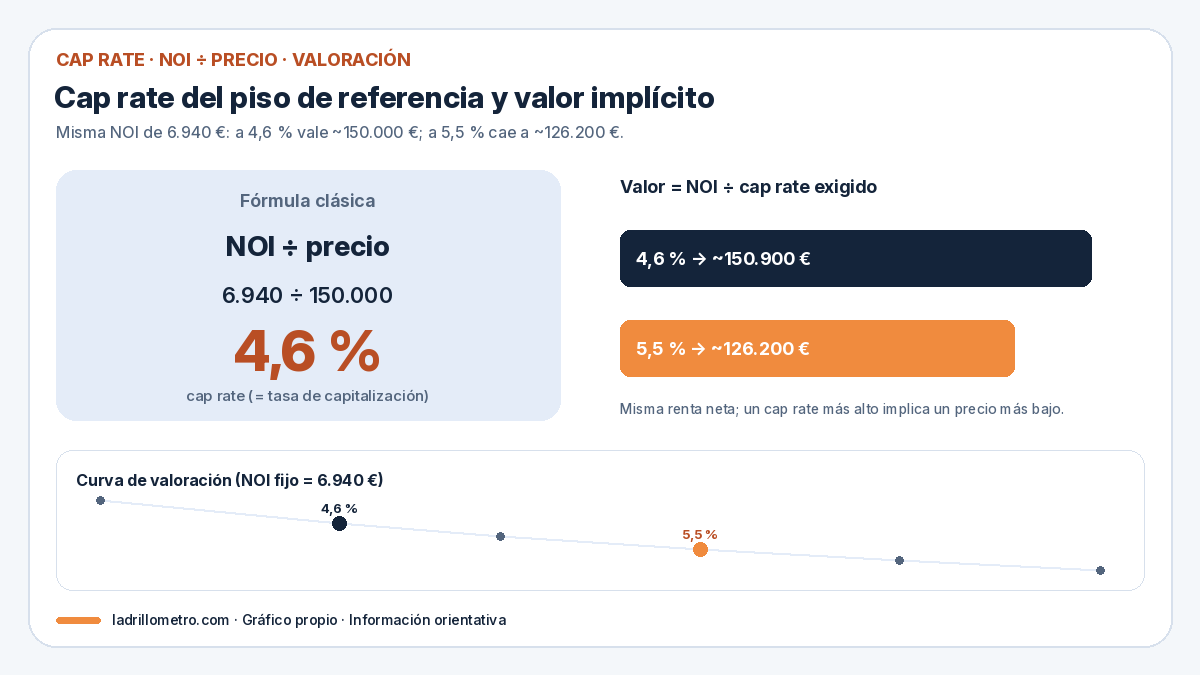
The cap rate (capitalization rate; in Spanish tasa de capitalización) is annual net operating income (NOI) divided by the property’s price. On Ladrillómetro’s reference flat: €6,940 ÷ €150,000 = 4.6%. It helps you compare flats and estimate a fair value: if the zone (or you) require 5.5%, that same NOI is worth about €126,200.
You can check the NOI and the calculator’s “cap rate” (on total cost) in the rental yield calculator. Below: the classic formula, how it differs from net and gross yield, and how to use it when negotiating price.
What is cap rate (capitalization rate)?
In property investing, cap rate summarises in one percentage how much the asset returns before mortgage and income tax, relative to its price. Spanish texts often call it tasa de capitalización.
It measures the asset, not how you financed it: the numerator is NOI (rent collected minus operating costs) and the classic denominator is the purchase price (or the market value you are testing). It does not include the mortgage payment or your marginal tax rate.
Spanish residential listings use it less than offices or retail, but it is the same idea as “net yield on price” in the guide on gross yield, net yield and cash-on-cash.
How do you calculate cap rate?
Cap rate = NOI ÷ price (or value) × 100
Steps with the reference flat:
- Rent collected: €850 × 11 months = €9,350 (one empty month).
- Operating costs: property tax €400 + community fees €960 + insurance €550 + maintenance €500 = €2,410.
- NOI: 9,350 − 2,410 = €6,940.
- Classic cap rate: 6,940 ÷ 150,000 = 4.633…% → 4.6%.
If you divide the same NOI by total investment (price + purchase costs + refurb = €170,000) you get 6,940 ÷ 170,000 = 4.1%. That is no longer the classic cap rate: it is net yield on what it cost you to get the flat ready to let.
Ladrillómetro’s calculator labels “Cap rate” as NOI ÷ total cost (~4.08% in the example). Always check the denominator before you compare two figures.
Cap rate vs net yield vs gross yield
| Metric | Numerator | Denominator | Example |
|---|---|---|---|
| Gross yield | Annual rent (no vacancy or costs) | Price | 10,200 ÷ 150,000 = 6.8% |
| Classic cap rate | NOI | Price | 6,940 ÷ 150,000 = 4.6% |
| Net yield | NOI | Total investment | 6,940 ÷ 170,000 = 4.1% |
| Calculator “cap rate” | NOI | Total cost | ~4.08% |
Gross ignores vacancy and costs. Classic cap rate and net yield share NOI but change the denominator: price versus everything you paid. None of the three subtracts the mortgage; that belongs in cash flow and cash-on-cash.
What is the cap rate on the €150,000 flat?
Reference-flat summary (same assumptions as the other guides):
| Item | Amount |
|---|---|
| Price | €150,000 |
| Purchase costs + refurb | €15,000 + €5,000 = €20,000 |
| Total investment | €170,000 |
| Rent collected (1 empty month) | €9,350 |
| Operating costs | €2,410 |
| NOI | €6,940 |
| Classic cap rate | 4.6% (6,940 ÷ 150,000) |
| Net on investment | 4.1% (6,940 ÷ 170,000) |
Open this example in the calculator
Inputs: price 150,000; rent 850; occupancy 91.67%; property tax 400; community fees 960; insurance 550; maintenance 500; loan 105,000; deposit 45,000; payment 497.92; purchase costs estimated at 10% and refurb 5,000. You will see NOI of €6,940 and a “cap rate” of ~4.08% on total cost (not the classic 4.6% on price).
How do you use cap rate to value a flat?
If you know (or estimate) NOI and the cap rate the market—or you—require, value is the inverse:
Value = NOI ÷ cap rate
- At 4.6%: 6,940 ÷ 0.046 ≈ €150,870 ≈ the example price (consistency check).
- If the area (or your hurdle) requires 5.5%: 6,940 ÷ 0.055 = €126,181.82 ≈ €126,200.
That gap (~€24,000) is a negotiation argument: same net rent, but a buyer who needs a higher yield can only pay less. It is not an official appraisal or a guaranteed market price—just a financial rule of three.
What is cap-rate compression?
Cap-rate compression means prices rising faster than NOI (or rates falling and investors accepting lower yields): the NOI ÷ price ratio falls. A lower cap rate implies, at constant NOI, a higher value.
For Spanish housing, idealista and Fotocasa mainly publish gross yields from asking prices (around 6.5% and 5.7% in Q2 2026), not cap rates. Those gross figures are not interchangeable with a 4.6% cap rate: vacancy and costs are missing. Detail and links in what is a good rental yield.
What are the limits of cap rate?
- No mortgage and no income tax: for your pocket, use cash flow, cash-on-cash and DSCR.
- Only as good as the NOI: skip the empty month or maintenance and the cap rate inflates.
- Denominator is not unique: price vs total investment changes the percentage (4.6% vs 4.1% here).
- Ignores appreciation and sale costs.
- Spanish residential has few homogeneous public “market cap rates”; use it to compare your own numbers or for an illustrative valuation, not as an official statistic.
As an illustrative band for the example (NOI ÷ price), something like 4%–6% sketches modest housing yields versus headline gross; it is not a published market standard.
Run your own numbers
Enter price, rent and costs to see NOI and the ratio on total cost. Then compare with classic cap rate (NOI ÷ price) by hand if you need it.
Open the rental yield calculator
This is general information, not financial or tax advice.