A good rental yield isn't a single number: it depends on whether you look at gross yield, net yield or what's left after the mortgage and income tax. In Spain, the average gross yield on housing was around 6.5% in Q2 2026 (idealista) or 5.7% (Fotocasa), both based on asking prices. On Ladrillómetro's reference flat, 6.8% gross ends up as 4.1% net and 1.2% cash-on-cash after income tax.
You can check these figures against your own in the rental yield calculator. Below you'll see which measure to compare, what the market benchmarks say and how to set your own threshold.
What counts as a good yield on a rental?
The short, honest answer: there's no official threshold. What you can do is place your flat against three anchors:
- The market gross yield on housing in Spain (around 5.7%–6.5% in Q2 2026, depending on the source).
- The property's net yield, which on cautious assumptions is usually 2 or 3 points below the listing's gross figure.
- What's left for you (cash flow and cash-on-cash), especially if there's a mortgage and income tax.
A 6%–7% gross yield in a listing isn't “bad” or “good” on its own: it can be a good buy if net yield and cash flow hold up, or a trap if you forget empty months, costs and tax. So the useful question isn't “what is a good rental yield?” in the abstract, but “good by which measure, and compared with what alternative?”.
What is the average rental yield in Spain in 2026?
Two public benchmarks for Q2 2026, both gross yields calculated from asking prices (not from completed sales, and not an investor's net figure):
| Source | Date | Gross yield, housing, Spain | Notes |
|---|---|---|---|
| idealista (via Europa Press) | 6/7/2026 | 6.5% (7.2% a year earlier) | Madrid 4.7%; Barcelona 5.2%. Offices 10.9%, retail premises 9.9%, garages 6%. 10-year bond 3.4%. Method: asking sale price ÷ asking rent. |
| Fotocasa Research | 28/7/2026 | 5.7% (6.7% in 2021) | Also gross on asking prices; a different method from idealista's, which is why they don't match. |
Neither 6.5% nor 5.7% is a “good net yield” or a cash-on-cash figure. They're gross averages from listings (both sources in Spanish). If your flat comes in below that range on a gross basis, it isn't automatically a bad investment (there may be capital growth, less risk or a better location); if it comes in above, that doesn't guarantee healthy cash flow after costs and mortgage.
To see the official gross yield by municipality (appraisal price and rent from public sources, not property portals), use the property data section.
Gross, net or after tax: which should you compare?
With the same reference flat (€150,000 price, €15,000 of buying costs, €5,000 of works, €850/month with one empty month), you get very different figures:
| Measure | Calculation | Result | What it's for |
|---|---|---|---|
| Gross on the price | 10,200 ÷ 150,000 | 6.8% | Comparing listings and market headlines |
| Gross on the total investment | 10,200 ÷ 170,000 | 6.0% | Same rent, counting ITP and works |
| Net (NOI ÷ total investment) | 6,940 ÷ 170,000 | 4.1% | Measuring the property without financing |
| Classic cap rate (NOI ÷ price) | 6,940 ÷ 150,000 | 4.6% | Comparing with sources that use the price only |
| Cash-on-cash before income tax | 965 ÷ 65,000 | 1.5% | What your money earns with a mortgage |
| Cash-on-cash after income tax (year 1) | 762 ÷ 65,000 | 1.2% | Roughly what ends up in your pocket |
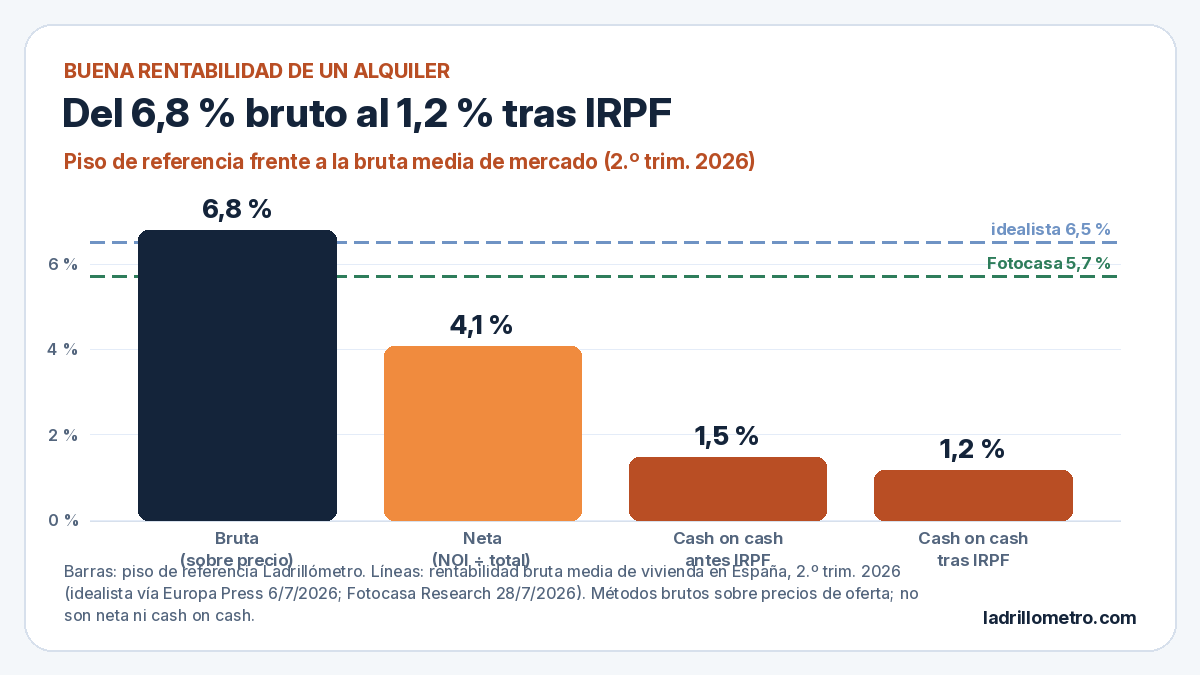
If someone asks you “what's a good net yield on a rental?”, the fair comparison is with other investments of similar risk and with your opportunity cost, not with idealista's 6.5% gross. Each formula is explained in the guide to gross yield, net yield and cash-on-cash; getting from NOI to monthly money is covered in the cash flow guide.
Open this example in the calculator
The link fills in the price and the rent. The rest of the example: occupancy 91.67%; IBI 400; community fees 960; insurance 550; maintenance 500; loan 105,000; deposit 45,000; payment 497.92; buying costs estimated at 10% and works 5,000. You'll see an NOI of €6,940, a “cap rate” of 4.08%, cash-on-cash of about 1.5% and a DSCR of 1.16.
What is the opportunity cost against bills, deposits or the stock market?
The money you put into the flat (€65,000 of your own capital in the example) could be somewhere else. Three useful reference points, without claiming they're investment advice:
- Long-term government debt. In idealista's July 2026 report, the Spanish 10-year bond was quoted at 3.4%. It's a different nominal return (liquidity, risk and tax aren't those of a flat), but it works as a floor: if your net yield or cash-on-cash is below it and you don't expect capital growth, the flat competes poorly on pure return.
- Deposits and short-term bills. When rates are high they usually pay less than a 10-year bond, but with less volatility and no community levies or tenants.
- The stock market (indices). Historically it has offered higher expected returns in exchange for more volatility. A flat with 1.2% cash-on-cash after tax doesn't automatically “lose” to the stock market: it brings leverage, debt repayment and, often, capital growth; but it does mean you have to justify the operational risk (empty months, unpaid rent, works).
The question “what net yield is worth it compared with the stock market?” has no magic number. It's worth it if, adding cash flow, the debt you pay down and the capital gain you expect, the whole package beats your alternative by a margin that makes up for the work and the property risk.
Why does a high yield usually come with more risk?
In the same idealista report, offices (10.9%) and retail premises (9.9%) yield more on a gross basis than housing (6.5%), and Madrid (4.7%) and Barcelona (5.2%) yield less than the national average. That's no coincidence:
- A higher gross yield in the listing usually means a weaker location, more tenant turnover, more work outstanding or a less liquid market.
- A lower gross yield in big cities usually comes with more rental demand, easier resale and, often, more hope of capital growth.
- Garages and storage rooms can show attractive gross yields, but with small tickets, fewer comparables and a different cost profile.
A “good rental yield” that ignores risk is just a headline. If a flat promises 9% gross in an area with lots of empty supply, work out net yield with two empty months and high maintenance before you get excited.
How do you set your own yield threshold?
Instead of looking for “the” good number, set three filters in sequence:
- Listing filter (gross). Quickly rule out anything well below the gross yield for your area (check property data or the portals, bearing in mind they show asking prices). The reference flat, at 6.8%, sits within the range of idealista's national average.
- Property filter (net). Require a net yield that at least leaves you a margin over your opportunity cost. In the example, 4.1% net is mediocre against a bond at 3.4% if there's no capital gain; it may be worth it if you expect rents or the price to rise.
- Pocket filter (cash flow and DSCR). The rent should cover the mortgage with room to spare (a DSCR of at least ~1.2 if you want to sleep at night), and cash-on-cash after a cautious income tax estimate shouldn't force you to fund the flat from your salary every month.
Your threshold also depends on whether you're buying to live in one day, for cash flow or for capital growth; on whether you can put down a bigger deposit; and on the autonomous community (ITP changes the total investment). Don't copy a headline's 6.5% as if it were your cash-on-cash target.
Run your own numbers
Enter the price, rent, costs and mortgage and see gross yield, net yield, cash flow, cash-on-cash and DSCR in real time. Free, no sign-up.
Open the rental yield calculator
For information only; this is not financial or tax advice.