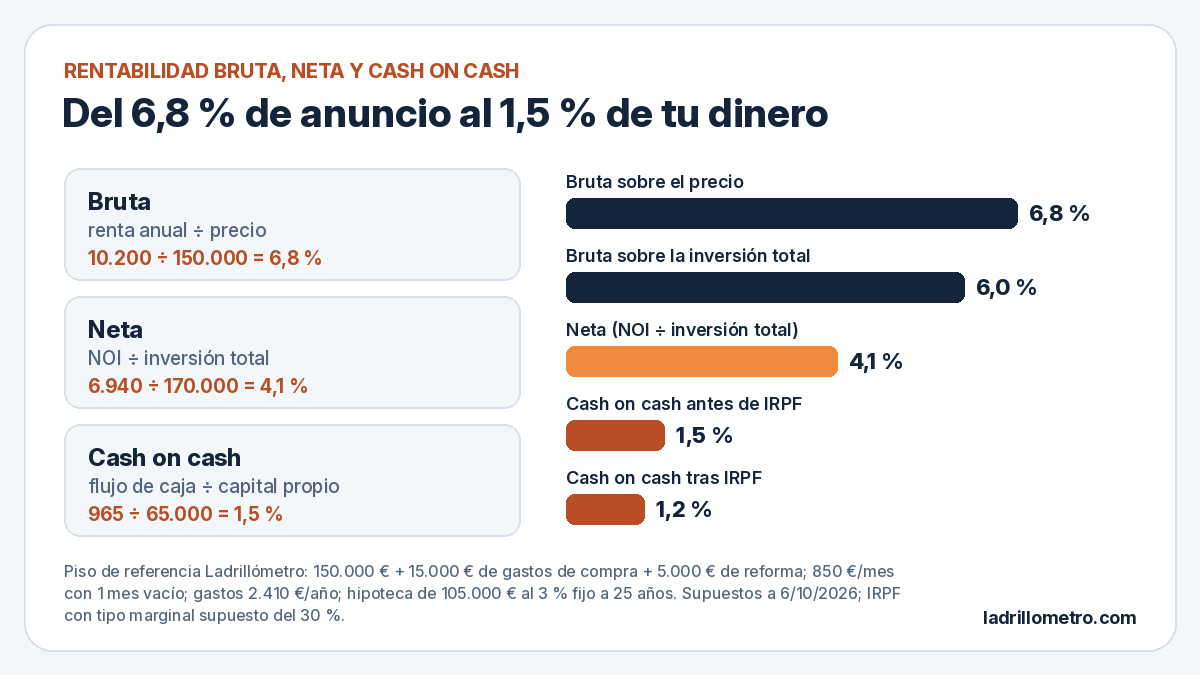
Gross yield divides a year's rent by the purchase price. Net yield first takes off running costs and empty months, then divides by everything it cost you to buy the flat. Cash-on-cash return measures what your own money earns once the mortgage has been paid. On our €150,000 reference flat that works out at 6.8% gross, 4.1% net and 1.5% cash-on-cash.
You can rerun these numbers with your own figures in the rental yield calculator. Below we go through each formula, where every figure comes from, and why the gap between the three is so wide.
What is gross rental yield and how is it calculated?
It's the quick number, the one you see in listings and headlines: how much rent the flat brings in each year compared with its price.
Gross yield = monthly rent × 12 ÷ purchase price × 100
With €850 a month and a €150,000 price: 850 × 12 = €10,200 a year, and 10,200 ÷ 150,000 = 6.8%. It ignores purchase taxes and fees, months without a tenant, day-to-day running costs and the mortgage. It's good for comparing two similar flats in the same area in a minute, and for ruling out the ones that don't even reach a minimum, but not for deciding to buy.
Ladrillómetro's calculator doesn't show gross yield as a result of its own: it starts straight from the income you expect to collect, with occupancy already applied.
How do you calculate net yield?
Net yield answers a more useful question: how much the flat leaves you, after its costs, for every euro it took to get it up and running.
Net yield = (rent collected − running costs) ÷ total investment × 100
- Rent collected: annual rent minus the months you expect the flat to be empty.
- Running costs: IBI (the annual local property tax), community fees for the building, insurance (buildings and contents and, if you take it out, rent-default cover), maintenance and repairs, and agency management if you hand it over.
- Total investment: price + buying costs (taxes, notary, land registry, gestoría paperwork, valuation) + initial refurbishment.
The top line is called NOI (net operating income). In the example: €9,350 collected − €2,410 of costs = €6,940, and 6,940 ÷ 170,000 = 4.1%. Net yield leaves out the mortgage and income tax: it measures the property, not how you paid for it or what you personally pay in tax.
In the calculator this figure is labelled “Cap rate” (net income ÷ total cost): 4.08% in the example. Bear in mind that other sources work out cap rate on the purchase price alone, without buying costs or works, and on this flat that would give 4.6%. Before comparing two figures, always check what they divide by.
Should you divide by the price or by the total investment?
Both are fine as long as you say which one you're using, but they give very different numbers for the same flat:
| Measure | Calculation | Result |
|---|---|---|
| Gross on the price | 10,200 ÷ 150,000 | 6.8% |
| Gross on the total investment | 10,200 ÷ 170,000 | 6.0% |
| Net on the price (classic cap rate) | 6,940 ÷ 150,000 | 4.6% |
| Net on the total investment | 6,940 ÷ 170,000 | 4.1% |
To make a decision, use the total investment. The €15,000 of buying costs and €5,000 of works come out of your pocket just like the price, and you don't get them back the next day. The price is for comparing listings; the total investment tells you what your money is really earning.
What is cash-on-cash and how is it different from ROI?
If you buy with a mortgage, the question changes: it's no longer just what the flat returns, but what your money returns, the cash you put in as a deposit and costs.
Cash-on-cash = (NOI − annual mortgage payments) ÷ your own capital × 100
The top line is the annual pre-tax cash flow. Your own capital is everything you pay without borrowing: deposit + buying costs + works. In the example, 45,000 + 15,000 + 5,000 = €65,000, and the cash flow is 6,940 − 5,975 = €965 a year. Result: 965 ÷ 65,000 = 1.5%.
The calculator also shows an ROI, which divides that same cash flow by the total cost of the flat (965 ÷ 170,000 = 0.57%). Cash-on-cash is more useful when there's a mortgage, because it compares the result with the money you actually have tied up.
What does a €150,000 flat really return?
This is the reference flat we use across all Ladrillómetro guides. The inputs are reasonable assumptions, not a specific property, and they're set out in the assumptions box further down.
| Item | Calculation | Amount |
|---|---|---|
| Annual rent | €850 × 12 | €10,200 |
| Rent collected (1 empty month) | 10,200 − 850 | €9,350 |
| Running costs | IBI 400 + community fees 960 + home insurance 250 + rent-default insurance 300 + maintenance 500 | €2,410 |
| NOI | 9,350 − 2,410 | €6,940 |
| Total investment | 150,000 + 15,000 + 5,000 | €170,000 |
| Mortgage (70% of the price) | €105,000 at 3% fixed over 25 years: €497.92/month × 12 | €5,975 |
| Pre-tax cash flow | 6,940 − 5,975 | €965 (about €80/month) |
| Your own capital | 45,000 + 15,000 + 5,000 | €65,000 |
| Gross yield | 10,200 ÷ 150,000 | 6.8% |
| Net yield | 6,940 ÷ 170,000 | 4.1% |
| Cash-on-cash | 965 ÷ 65,000 | 1.5% |
Open this example in the calculator
The link fills in the price and the rent; enter the rest yourself: occupancy 91.67% (one empty month); IBI 400; community fees 960; insurance 550 (home + rent default); maintenance 500; management and other costs 0; loan amount 105,000; deposit 45,000; monthly payment 497.92; leave “Estimate 10% of the price” ticked (€15,000 of buying costs) and put 5,000 under works. You'll see an NOI of €6,940, cash flow of +€965 a year, a “cap rate” of 4.08% and cash-on-cash of 1.49% (91.67% rounds occupancy up slightly; with exactly 11 months it comes to 1.48%).
Why is net yield so much lower than gross?
Because two things creep in between them that the listing doesn't show. The first is what you divide by: adding buying costs and works to the price brings the yield down from 6.8% to 6.0% without touching the rent. The second is costs and the empty month: of the €10,200 of theoretical rent, €850 is lost to the month without a tenant and €2,410 goes on costs. That's almost a third of the rent (3,260 ÷ 10,200 = 32%), and it takes the yield from 6.0% down to 4.1%.
None of those costs is inflated: we haven't included agency management, one-off levies from the building's community or major repairs. If you have them, net yield drops further still.
Does a mortgage raise or lower cash-on-cash?
It depends on what the loan costs you compared with what the flat earns. If you buy outright, your own capital is the full €170,000 and cash-on-cash equals net yield: 4.1%. With a 70% mortgage it falls to 1.5%, even at an interest rate of only 3%.
The reason is the monthly payment. Each year you pay €5,975 on a €105,000 loan, i.e. 5.7% of the amount borrowed, because the payment covers both interest and capital repayment. That 5.7% is more than the 4.1% the flat generates, so the cash flow gets squeezed.
That said, the capital part of the payment isn't a cost: it's debt you no longer owe. In the first year you repay about €2,864 of capital and pay about €3,111 of interest. If you add that capital to the cash flow, the year-1 return on your money would be (965 + 2,864) ÷ 65,000 ≈ 5.9%, before tax and without counting any rise in value. Cash-on-cash doesn't capture it because it only measures the money that reaches your account, which is exactly what you need to know so you don't run short of cash.
Does the rent cover the mortgage comfortably here? We measure that with the DSCR, which is 1.16 in this case: it covers it, but with little room to spare.
How many years does it take to get your money back?
Spanish investors often talk about the “PER inmobiliario”, which flips yield around: instead of a percentage, it says how many years of rent it takes to pay for the flat. With the listing figure, 150,000 ÷ 10,200 = 14.7 years. With net figures, 170,000 ÷ 6,940 = 24.5 years. It's an intuitive way of seeing the same thing as the table above, with the same limits: it ignores financing, tax, rising rents and costs, and what the flat will be worth when you sell.
What mistakes do people make when calculating yield?
- Comparing one flat's gross yield with another's net yield. A gap of 2 or 3 points can be down to method alone.
- Forgetting buying costs. The purchase tax (ITP on resale homes) depends on the autonomous community and is a big part of the investment. Work out yours with the home buying costs calculator.
- Assuming 12 months of rent. A single empty month a year cuts the rent by 8.3%.
- Leaving out maintenance or rent-default insurance. They're small month to month, but in the example they add up to €800 a year.
- Putting the mortgage into net yield. Net yield measures the property; the mortgage belongs in cash flow and cash-on-cash.
- Forgetting income tax. In the example, first-year income tax (IRPF) is about €203 and brings cash-on-cash down to 1.2% (762 ÷ 65,000). We work it out step by step in the cash flow guide.
Run your own numbers
Try the price, rent and costs of the flat you're looking at. The calculator gives you NOI, net yield on total cost, cash flow, cash-on-cash and DSCR in real time.
Open the rental yield calculator
For information only; this is not financial or tax advice.