Under the 35% rule (maximum payment = 35% of your net income), a €2,000 net salary supports a €700 payment and, over 30 years at a fixed 3%, about €166,000 of mortgage. That is an illustrative estimate: Spanish banks also look at other debts, income stability and how much deposit you can put down.
How much mortgage you can get comes down mainly to the monthly payment the bank will accept. Try your own numbers in the mortgage affordability calculator (set your net salary) and check the payment in the mortgage calculator. Below you will find the formula, a salary table and what changes if you already have debts or you are buying to let.
How much mortgage can I get with my salary? (short answer)
Spanish banks usually place the effort ratio (all debt payments ÷ net income) around 30%–35%, and the Banco de España’s Banking Customer Portal (in Spanish) warns that total indebtedness should not exceed 40% of net income. This guide uses 35% as a common, prudent starting point.
Steps:
- Maximum payment = monthly net income × 0.35 (minus other monthly debt payments, if any).
- Maximum mortgage = the principal that payment can amortise at a given term and rate (French amortisation / annuity).
Example: €2,000 net × 35% = €700/month. Over 30 years at a fixed 3%, that finances about €166,000. At the current 3.247% rate (1-year Euríbor for September 2026), it falls to about €160,900.
How do you turn a maximum payment into a loan amount?
The maximum payment is simple:
Max payment = net income × ratio (here 0.35), after subtracting other monthly debts.
The principal (mortgage) comes from the present value of a French annuity (level payment):
Mortgage = payment × [1 − (1 + r)−n] ÷ r, where r is the monthly rate (annual rate ÷ 12) and n is the number of months.
With r = 0.03 ÷ 12 and n = 360, a €700 payment gives €166,033 (we round to ~€166,000 in the prose). These are exact results of that formula—the same maths a French-amortisation calculator uses.
Calculate my mortgage affordability Simulate the payment
Table: maximum mortgage by net salary (2026)
Assumptions: 35% ratio, 30 years, no other debts, French amortisation. Two rates: 3% fixed (worked example) and 3.247% (1-year Euríbor for September 2026, published by Banco de España on 1/10/2026, BOE-A-2026-20519 — in Spanish). Table figures rounded to the nearest hundred; the chart uses the same rounding.
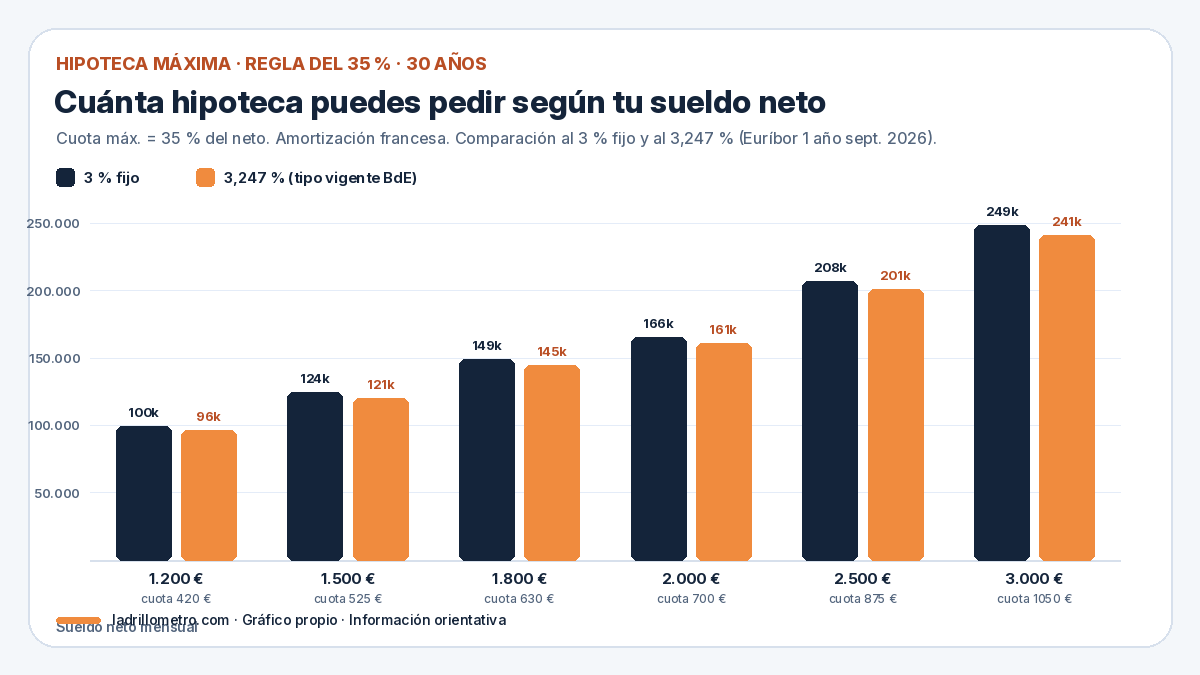
| Net salary | Max payment (35%) | Mortgage at 3% | Mortgage at 3.247% |
|---|---|---|---|
| €1,200 | €420 | €99,600 | €96,500 |
| €1,500 | €525 | €124,500 | €120,700 |
| €1,800 | €630 | €149,400 | €144,800 |
| €2,000 | €700 | €166,000 | €160,900 |
| €2,500 | €875 | €207,500 | €201,100 |
| €3,000 | €1,050 | €249,000 | €241,400 |
Exact figures before rounding (3%): €99,620 · €124,524 · €149,429 · €166,033 · €207,541 · €249,049. At 3.247%: €96,542 · €120,678 · €144,814 · €160,904 · €201,130 · €241,356.
The “mortgage with a €2,000 salary” row is the most searched in this set: ~€166,000 at 3% or ~€160,900 at the current rate, always with no other debts and a 35% effort ratio.
Beyond salary: how much cash do I need?
What your pay cheque can service is not enough on its own. For a primary home, Spanish banks usually lend at most about ~80% of the appraisal value (sometimes less). That implies:
- ~20% deposit of the price (or of the lower of price and appraisal).
- Purchase costs (transfer tax / ITP or VAT, notary, land registry, agency, appraisal): often another ~10%–12% of the price on a resale, depending on the autonomous community.
Rough example: if the bank lends €166,000 at 80% LTV, the appraised flat would be around ~€207,500 and you would need roughly €41,500 deposit plus purchase costs (tens of thousands more depending on ITP). Payment capacity without enough cash still will not close the deal.
What if I already have other debts?
The ratio covers all instalments (car loan, personal loan, revolving cards…), not only the mortgage. If you earn €2,500 net and already pay €150 on another debt:
- Available payment = 2,500 × 35% − 150 = €725.
- Mortgage at 3% / 30 years ≈ €172,000 (exact: €171,962), versus ~€207,500 without that debt.
A small debt cuts the loan a lot because it subtracts every month for the whole term. Clear or shrink instalments before you apply if you can.
Couples, self-employed and extra pays
- Couple / two borrowers: net incomes (and debts) are added. Two €1,500 net salaries ≈ a €3,000 household → in the table, ~€249,000 at 3% if there are no other debts.
- Extra pays (pagas extra): many banks annualise (×14 or a monthly average). Ask how yours is counted; do not assume the gross payslip figure.
- Self-employed: banks usually want more history (tax filings, social security) and may use a tighter ratio or haircut income. The table remains a theoretical ceiling, not an offer.
Buying to let: LTV and rent
On a second home or buy-to-let purchase the bank usually:
- Lends less (LTV often ~60%–70%, not the ~80% of a primary home).
- Counts only part of expected rent (or none) when assessing affordability, and leans more on your salary.
For you as an investor, the useful question is not only “how much will they lend me?” but whether the rent covers the payment with a margin: that is DSCR. Pair it with net yield and cash-on-cash in the guides on good rental yield and gross, net and cash-on-cash.
Run your own numbers
Enter your net salary (and other debts) in the mortgage affordability calculator, then check terms and rates in the mortgage calculator. Free, no sign-up.
Open the mortgage affordability calculator Open the mortgage calculator
For information only; this is not financial or tax advice.