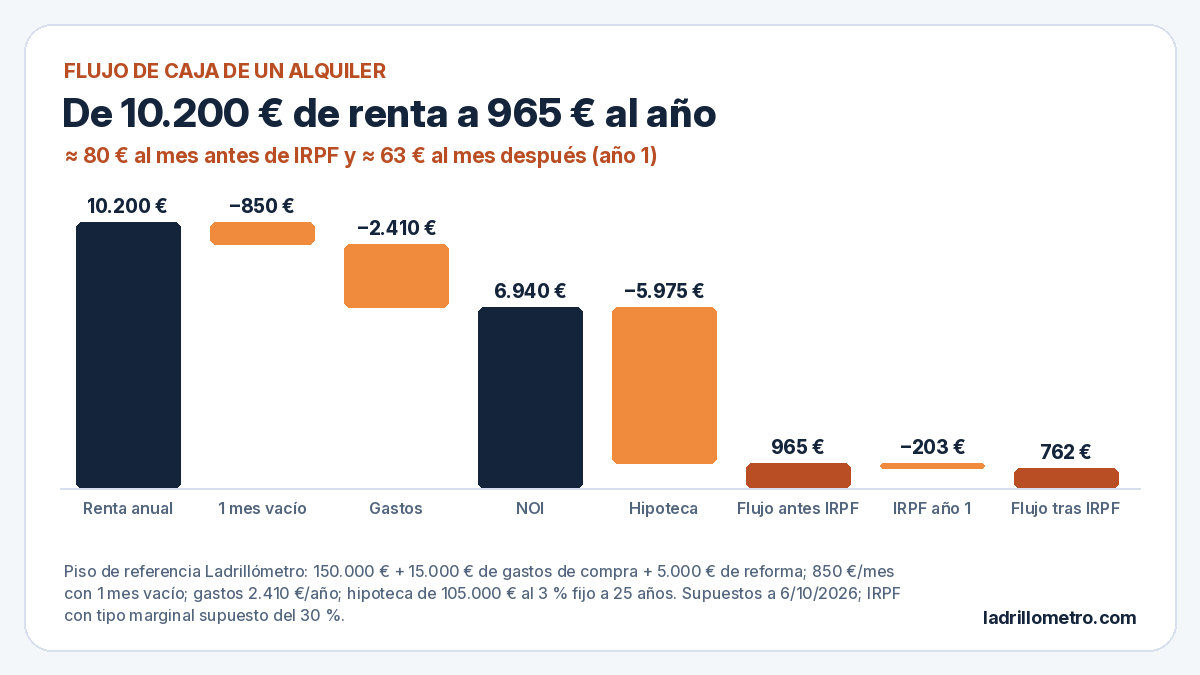
The cash flow of a rental is the money left over after you collect the rent and pay the running costs, the mortgage and tax: rent collected − costs − mortgage payments − income tax. On Ladrillómetro's reference flat, €850 a month of rent leaves about €965 a year (€80 a month) before tax and about €762 after.
To work out yours, use the rental yield calculator: it shows monthly and annual cash flow as you change the inputs. Here you have the formula step by step, the list of costs and a worked example.
What is rental cash flow?
It's the difference between what comes into your account from the flat and what goes out on it over a period, usually a year, then divided by 12 to see it month by month.
It isn't the same as net yield. Net yield measures the property without regard to how you paid for it; cash flow includes the mortgage, because that's money leaving your pocket every month. A flat can have a decent net yield and almost no cash flow if the mortgage payment is high. Cash flow tells you whether the flat pays for itself or whether you'll be topping it up every month.
What is the cash flow formula, step by step?
- Annual rent: monthly rent × 12.
- Minus empty months: multiply by expected occupancy (11 months out of 12 is 91.67%).
- Minus running costs: IBI, community fees, insurance, maintenance, management. The result is NOI (net operating income).
- Minus mortgage payments: monthly payment × 12, interest and capital. The result is pre-tax cash flow.
- Minus the income tax due on that rental income. The result is after-tax cash flow.
Annual cash flow = rent × 12 × occupancy − annual costs − monthly payment × 12 − income tax
Ladrillómetro's calculator does the first four steps, exactly like this formula. We work out income tax separately, further down, because it depends on your marginal rate and the type of lease.
What costs does a rental flat have in Spain?
These are the reference flat's annual costs. They're a guide only: yours will depend on the municipality, the building and the condition of the flat.
| Cost | In the example | Comment |
|---|---|---|
| IBI (local property tax) | €400 | Set by the town hall; it's on the previous year's bill. |
| Community fees | €960 | €80 a month. Ask the seller for the community's minutes in case one-off levies (derramas) have been approved. |
| Home insurance | €250 | Buildings and third-party liability. |
| Rent-default insurance | €300 | Optional, but it reduces the costliest risk of letting. |
| Maintenance | €500 | A reserve for breakdowns and small repairs. |
| Management | €0 | If an agency manages the let, add its fee. |
| Total | €2,410 | 24% of annual rent. |
Two things are left out on purpose: utilities, which tenants pay under many contracts (if you pay them, add them), and one-off community levies, which aren't yearly but are worth allowing for in your buffer. The mortgage payment isn't a running cost either: it comes in the next step.
How much cash flow does a €150,000 flat leave?
The reference flat costs €150,000, plus €15,000 of buying costs and €5,000 of works. It's let for €850 a month with one empty month a year, and financed with a €105,000 mortgage (70% of the price) at 3% fixed over 25 years, with a payment of €497.92 a month.
| Step | Calculation | Per year | Per month |
|---|---|---|---|
| Annual rent | 850 × 12 | €10,200 | €850 |
| Empty month | −850 | −€850 | −€71 |
| Running costs | see table above | −€2,410 | −€201 |
| NOI | 9,350 − 2,410 | €6,940 | €578 |
| Mortgage | 497.92 × 12 | −€5,975 | −€498 |
| Pre-tax cash flow | 6,940 − 5,975 | €965 | €80 |
| Year-1 income tax | see next section | −€203 | −€17 |
| After-tax cash flow | 965 − 203 | €762 | €63 |
Open this example in the calculator
The link fills in the price and the rent; enter the rest yourself: occupancy 91.67%; IBI 400; community fees 960; insurance 550 (home + rent default); maintenance 500; management and other costs 0; loan amount 105,000; deposit 45,000; monthly payment 497.92 (you can get it from the mortgage calculator, which rounds it to €498); leave “Estimate 10% of the price” ticked and put 5,000 under works. You'll see cash flow of +€80 a month and +€965 a year, and a break-even rent of €762.
Eighty euros a month is a thin margin: a €1,000 repair or a second empty month wipes out the whole year. That's why it's worth looking at the DSCR too, which is 1.16 here.
How does income tax affect cash flow?
Spanish income tax (IRPF) isn't charged on cash flow but on the net income from property (rendimiento neto del capital inmobiliario): income minus deductible expenses. The difference matters because only the interest on the mortgage is deductible, not the capital, and because you deduct depreciation on the property, which isn't an actual payment. This is a simplified first-year calculation for a Spanish tax resident:
| Item | Amount |
|---|---|
| Income (rent collected) | €9,350 |
| Running costs (IBI, community fees, insurance, maintenance) | −€2,410 |
| Year-1 mortgage interest | −€3,111 |
| Depreciation: 3% × €82,500 (building assumed to be 50% of €165,000) | −€2,475 |
| Net income | €1,354 |
| General 50% reduction (residential, lease from 26/05/2023) | −€677 |
| Reduced net income | €677 |
| Income tax at an assumed 30% marginal rate | €203 |
Deductible depreciation is at most 3% of the higher of two values, both excluding the land: the acquisition cost of the building (price and buying costs) or the cadastral value of the building. If you don't know the land value, the Spanish Tax Agency (AEAT) says to split the cost using the cadastral values of land and building shown on the IBI bill. In the example we assume the building is 50%; if the works count as an improvement they're depreciated too (we've left them out here to keep things simple).
The reduction depends on the lease: 50% is the general rate for residential leases signed from 26 May 2023, and it can rise to 60%, 70% or 90% if certain conditions are met (recent renovation, young tenants or a rent cut in a stressed-market area, among others). Leases signed before that date keep 60%. It doesn't apply to seasonal or holiday lets. The tax is paid in the following year's income tax return, so it's worth setting it aside. These reductions are for Spanish tax residents; non-residents are taxed under different rules.
What happens to cash flow if rates rise or rent falls?
| Scenario | Calculation | Pre-tax cash flow |
|---|---|---|
| Reference | 9,350 − 2,410 − 5,975 | +€965/year (+€80/month) |
| Mortgage at 4% (€554.23/month) | 9,350 − 2,410 − 6,651 | +€289/year (+€24/month) |
| Two empty months | 8,500 − 2,410 − 5,975 | +€115/year (+€10/month) |
| Rent of €1,000/month | 11,000 − 2,410 − 5,975 | +€2,615/year (+€218/month) |
The minimum rent so as not to lose money before tax, collecting 11 months, is (2,410 + 5,975) ÷ 11 = €762 a month. The calculator shows it as the “break-even rent”. If your mortgage is variable, the rate moves with Euribor: the 12-month rate was 3.247% in September 2026.
Does negative cash flow ever make sense?
It can, but you need to know what you're buying. With negative cash flow you put money in every month in exchange for two things you don't see in your account: the capital you're paying back (about €2,864 in the first year in the example) and a possible rise in the flat's value, which nobody guarantees.
If you accept negative cash flow, make sure you can cover it from your salary for years, even with an empty month or a community levy, and that you don't depend on selling at a particular moment. If not, the risk isn't worth it.
How can you improve a rental's cash flow?
- Negotiate the price. It's the most powerful lever, because it lowers the mortgage and the purchase taxes at the same time.
- Put down a bigger deposit. With a €90,000 loan instead of €105,000 (60% of the price), the payment falls to €426.79 and cash flow rises to about €1,819 a year, though you tie up more money.
- Take a longer term. Over 30 years, the payment on €105,000 at 3% would be €442.68 and cash flow about €1,628 a year, in exchange for paying almost €10,000 more interest in total.
- Cut empty months. A good listing, a sensible price and a flat in good condition are worth more than any trick.
- Review insurance and costs every year, without dropping the cover that protects you from the serious stuff.
- Update the rent when it's due, within legal and contractual limits. Spain's statistics office (INE) publishes the reference index for updating residential leases (IRAV); the rent update calculator tells you how much you can raise it.
Run your own numbers
Enter the rent, occupancy, costs and mortgage payment and see what's left each month. Try what happens with one more empty month or one more point of interest, too.
Open the rental yield calculator Work out the mortgage payment
For information only; this is not financial or tax advice.