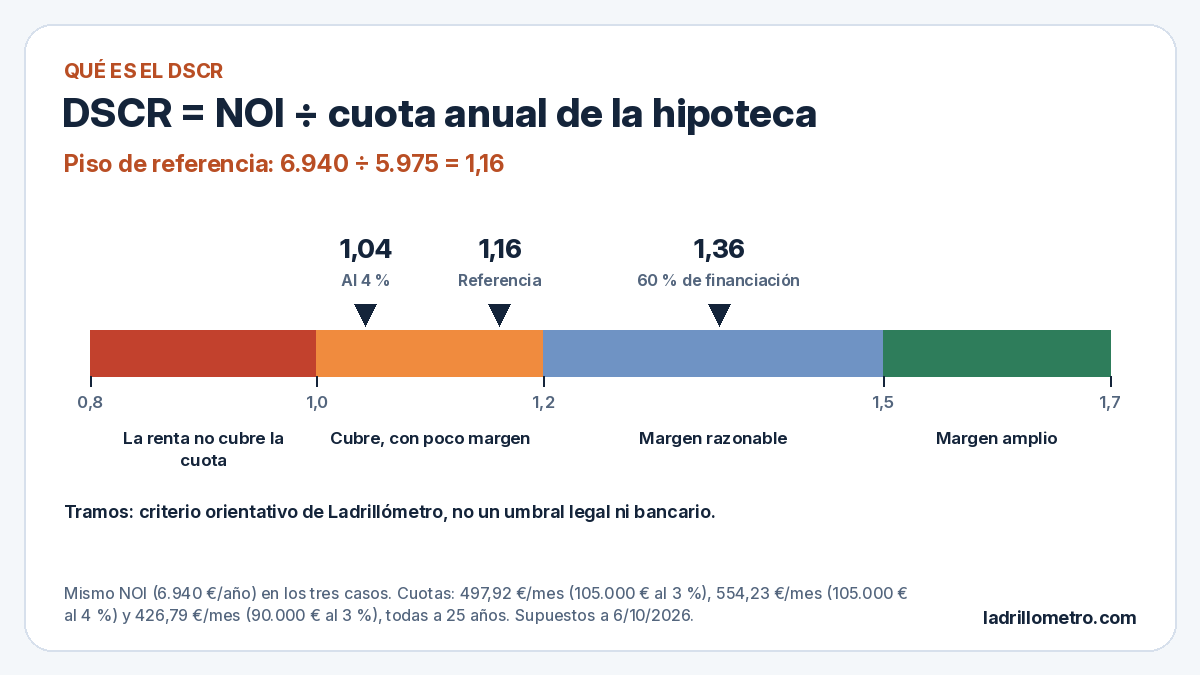
DSCR (debt service coverage ratio) divides the net income the rental generates by what you pay on the mortgage in a year. Above 1, the rent covers the payments; below 1, you have to put in money of your own. On Ladrillómetro's reference flat, €6,940 of net income against €5,975 of mortgage payments gives a DSCR of 1.16.
The rental yield calculator works it out automatically from your inputs, alongside cash flow. In this guide you'll see the formula, how to read it and what you can do to improve it.
What is DSCR and what does it measure?
DSCR stands for debt service coverage ratio: how many times a property's net income covers its debt payments. It's a safety-margin measure. It doesn't tell you how much you make, but how much things can get worse before the flat stops paying for itself.
A DSCR of 1.16 means that for every euro of mortgage payment, the flat generates €1.16 of net income. Put another way, net income could fall by 14% (1 − 1 ÷ 1.16) before the rent stopped covering the mortgage.
How is DSCR calculated?
DSCR = NOI ÷ annual mortgage payments
- NOI: rent collected in the year (after empty months) minus running costs.
- Annual payments (debt service): the monthly payment × 12, interest and capital. If you have another loan tied to the flat, for example for the works, add it.
DSCR is worked out before tax and doesn't include the deposit or buying costs: these affect how much you borrow, and so the payment, but they don't go into the formula. The calculator uses exactly this definition: net operating income ÷ annual mortgage.
What is NOI and which costs does it include?
NOI (net operating income) is what the flat leaves before financing and tax. On the reference flat:
| Item | Annual amount |
|---|---|
| Rent: €850 × 12 | €10,200 |
| One empty month | −€850 |
| IBI (local property tax) | −€400 |
| Community fees | −€960 |
| Home (€250) and rent-default (€300) insurance | −€550 |
| Maintenance | −€500 |
| NOI | €6,940 |
NOI is the same number used for net yield. If you leave costs out, DSCR looks better than it really is: a DSCR is only as reliable as the costs you put in.
How do you read a DSCR of 0.9, 1.0, 1.2 or 1.5?
There's no legal threshold for an individual's DSCR. The bands in this table are Ladrillómetro's own rule of thumb, designed for residential buy-to-let flats. To make them concrete, the table shows the annual payment that gives each DSCR with the example's NOI (€6,940):
| DSCR | Annual payment with €6,940 NOI | Left over per year | Indicative reading |
|---|---|---|---|
| 0.9 | €7,711 | −€771 | The rent doesn't cover the payment: you put money in every month. |
| 1.0 | €6,940 | €0 | Just covers it; any surprise comes out of your pocket. |
| 1.2 | €5,783 | +€1,157 | A reasonable margin for an empty month or a repair. |
| 1.5 | €4,627 | +€2,313 | A wide margin; usually means a bigger deposit or a low rate. |
Below 1.0, the flat doesn't pay for itself. Between 1.0 and 1.2 it does, but with little margin. From 1.2 the margin is reasonable, and from 1.5, wide. A high DSCR doesn't mean the investment is good: an expensive flat bought almost outright can also show a high DSCR. Use it together with cash flow and yield.
What DSCR does a €150,000 mortgaged flat have?
The reference flat costs €150,000 (plus €15,000 of buying costs and €5,000 of works), is let for €850 a month with one empty month a year and has an NOI of €6,940. Changing only the mortgage, over 25 years in every case:
| Mortgage | Payment | Calculation | DSCR |
|---|---|---|---|
| €105,000 (70%) at 3% fixed | €497.92/month = €5,975/year | 6,940 ÷ 5,975 | 1.16 |
| €105,000 (70%) at 4% | €554.23/month = €6,651/year | 6,940 ÷ 6,651 | 1.04 |
| €90,000 (60%) at 3% fixed | €426.79/month = €5,121/year | 6,940 ÷ 5,121 | 1.36 |
The base case, at 1.16, covers the payment with about €965 a year to spare. One more point of interest is enough to drop it to 1.04, with about €289 of margin. A second empty month (€850) would leave the base case with barely €115. With €15,000 more deposit, DSCR rises to 1.36 and the margin to about €1,819 a year.
What rent would it take to reach 1.2 with the base-case mortgage? NOI would have to be 1.2 × 5,975 = €7,170; adding back the costs and collecting 11 months, (7,170 + 2,410) ÷ 11 = about €871 a month.
Open this example in the calculator
The link fills in the price and the rent; enter the rest yourself: occupancy 91.67%; IBI 400; community fees 960; insurance 550; maintenance 500; management and other costs 0; loan amount 105,000; deposit 45,000; monthly payment 497.92; leave “Estimate 10% of the price” ticked and put 5,000 under works. You'll see a DSCR of 1.16×. For the other cases, change the payment to 554.23 (DSCR 1.04×) or the loan to 90,000 and the payment to 426.79 (DSCR 1.36×). You can check the payments in the mortgage calculator, which rounds them to the euro.
Do Spanish banks use DSCR?
To be honest: on mortgages to individuals, what counts is your personal creditworthiness, not the flat's DSCR. Article 11 of Law 5/2019 on real estate credit (in Spanish) requires lenders to assess the borrower's creditworthiness thoroughly before granting the loan, taking into account, among other factors, employment, current and expected income, assets, savings, fixed outgoings and existing commitments. The law sets no minimum DSCR.
In practice, with an individual the bank will mainly look at the debt-to-income ratio: how much of your income goes on debt. Expected rent may count in that assessment, but each lender has its own criteria. DSCR is above all a tool for you as an investor: it tells you whether the flat stands on its own two feet, even if the bank lends to you on the strength of your salary.
To see how much you could borrow based on your income, use the mortgage affordability calculator.
How can you raise a flat's DSCR?
- Borrow less. Going from 70% to 60% of the price raises DSCR from 1.16 to 1.36 in the example.
- Take a longer term. Over 30 years, the payment on €105,000 at 3% falls to €442.68 and DSCR rises to 1.31, though you pay almost €10,000 more interest in total.
- Get a lower rate or compare offers: each point of interest moves DSCR by more than a tenth on this flat.
- Negotiate the price, which reduces the loan you need.
- Raise NOI: fewer empty months, reviewed costs and a market rent, within the legal limits on rent updates.
Run your own numbers
Enter your rent, costs and mortgage payment, and see DSCR alongside cash flow. Then try one more point of interest or one more empty month to see how much margin you have.
Open the rental yield calculator Work out the mortgage payment
For information only; this is not financial or tax advice.